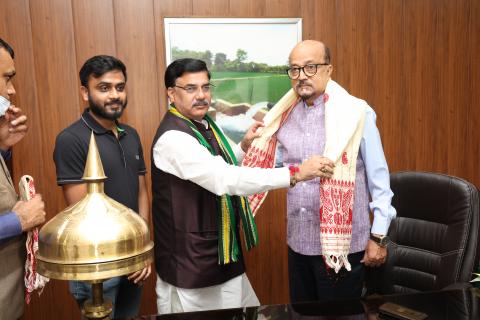
Governor Deka in governance engagements
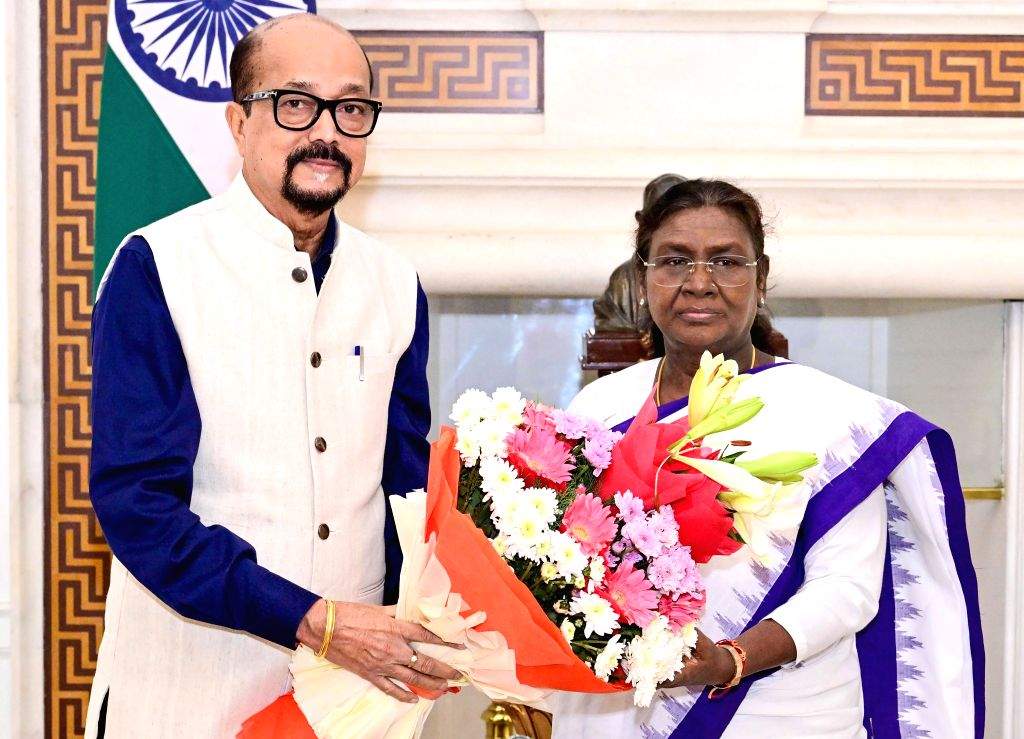
With Hon'ble President Droupadi Murmu
Deep analysis and strategic perspectives on governance, democracy, regional leadership, and national integration — drawn from four decades of immersion in India's political and constitutional landscape.
India's governance architecture is one of the most complex democratic systems in the world — a multi-layered edifice that spans the Union government, twenty-eight states, eight Union Territories, and a vast network of local self-government institutions. This complexity is not a design flaw but a deliberate constitutional response to the challenge of governing one of the most diverse nations in human history. Understanding this architecture — its strengths, its vulnerabilities, and its evolutionary trajectory — is essential for any serious engagement with the future of Indian democracy.
The framers of the Indian Constitution, drawing upon diverse intellectual traditions — from the Westminster parliamentary model to federal principles of governance — created a system that sought to balance competing imperatives: unity and diversity, centralization and decentralization, individual rights and collective welfare, stability and responsiveness. Seven and a half decades later, this system has demonstrated extraordinary resilience, surviving challenges that would have fractured less robust institutional frameworks.
However, the governance challenges of the twenty-first century demand a fundamental recalibration of our institutional approach. The rise of technology, the acceleration of urbanization, the deepening of global economic integration, and the intensification of climate-related challenges require governance systems that are more agile, more data-driven, and more capable of coordinating across traditional jurisdictional boundaries.
The key governance challenge for contemporary India is not the absence of policies but the gap between policy formulation and implementation. This implementation gap — the distance between legislative intent and ground-level impact — is the central governance challenge that any reformer must confront. Addressing it requires not merely better bureaucratic management but a fundamental rethinking of how we design, deliver, and evaluate public services.
Effective governance in India demands what might be called "contextual competence" — the ability to understand that a policy designed in New Delhi must be adapted to the specific cultural, geographical, and economic contexts of Assam, Chhattisgarh, Tamil Nadu, or Rajasthan. This is not a call for policy inconsistency but rather an argument for implementation flexibility within a framework of shared national objectives. The experience of governing across multiple regions — as my own career has afforded — reinforces this insight: what works in one context may fail in another, not because the policy is flawed but because the implementation framework has not been sufficiently calibrated to local realities.
Looking ahead, Indian governance must embrace several transformative priorities: the digitization of service delivery, the empowerment of local self-government institutions, the professionalization of the civil service, the integration of citizen feedback into policy cycles, and the development of governance metrics that measure not just output but impact. These are not merely administrative reforms — they are the building blocks of a governance system capable of delivering on the constitutional promise of a just, equitable, and prosperous society.
India's adoption of the parliamentary system of democracy was one of the most consequential decisions made during the drafting of the Constitution. This system — in which the executive is accountable to the legislature, and the legislature is answerable to the people — has served India well through decades of social transformation, economic liberalization, and political realignment. Yet it would be naive to suggest that the system is without challenges or that it does not require thoughtful reform to meet the demands of a rapidly evolving society.
Having served two terms in the Lok Sabha, I can attest both to the extraordinary power of parliamentary democracy as a mechanism for representative governance and to the institutional stresses that the system faces. The parliamentary chamber, at its best, is a crucible of democratic deliberation — a space where the nation's most pressing concerns are debated, contested, and resolved through the civilized process of reasoned argument and democratic vote. At its worst, it can descend into disruption and dysfunction, with the very processes designed to facilitate democratic discourse being weaponized to prevent it.
The challenge of parliamentary reform is not merely procedural but cultural. It requires a renewed commitment — from legislators, from political parties, and from the electorate — to the fundamental principles that animate democratic governance: the supremacy of reason over rhetoric, the primacy of public interest over partisan advantage, and the recognition that legislative institutions derive their authority from the quality of their deliberations, not merely from the electoral mandates of their members.
Several specific reforms merit serious consideration. First, the committee system — the backbone of parliamentary oversight — requires strengthening. Parliamentary committees should be empowered with greater resources, more time, and clearer mandates to scrutinize legislation and evaluate executive performance. Second, the quality of legislative debate must be improved through better pre-legislative scrutiny, enhanced research support for parliamentarians, and a Parliamentary culture that rewards substantive contribution over performative politics.
Third, and perhaps most fundamentally, there must be a renewed emphasis on constituency representation. The parliamentary system derives its legitimacy from the link between the representative and the represented. This link is weakened when parliamentary sessions are cut short, when debates are disrupted, and when constituency work is subordinated to national political theatrics. Every parliamentarian owes a duty not only to the national discourse but also to the specific communities that entrusted them with the responsibility of representation.
The future of Indian parliamentary democracy depends on the ability of the current generation of political leaders to strengthen these institutions while adapting them to contemporary realities. Technology, for instance, can revolutionize parliamentary functioning — from enabling remote committee meetings to facilitating greater citizen participation in legislative processes. But technology alone is not the answer; it must be accompanied by a cultural commitment to democratic deliberation and institutional integrity.
India's federal structure creates a unique ecosystem for political leadership, one in which regional leaders play a role that is arguably more complex and demanding than that of their national counterparts. The regional political leader must simultaneously navigate local, state, and national dynamics, balancing constituency-specific demands with broader policy imperatives, managing ethnic and cultural diversity within their political context, and building bridges between the center and the periphery.
The Northeast of India, where my political career began, offers particularly instructive lessons about regional political leadership. The region's extraordinary linguistic, ethnic, and cultural diversity; its complicated history of insurgency and peace-building; its complex demographic dynamics; and its enduring aspiration for equitable development within the Indian Union — all of these factors demand a form of leadership that is simultaneously deeply rooted in local realities and broadly connected to national institutions.
Regional political leadership in India is often undervalued in national discourse, which tends to focus on Delhi-centric politics and national-level leaders. Yet it is the regional leader who translates national policies into local action, who mediates between community aspirations and governmental capacity, and who serves as the primary point of democratic interface for the vast majority of Indian citizens. The quality of governance in India is, in significant measure, determined by the quality of its regional political leadership.
Effective regional leadership requires a distinctive skill set: the ability to communicate across cultural boundaries, to build coalitions among diverse communities, to manage limited resources with maximum impact, and to maintain democratic accountability in contexts where the temptations of authoritarianism may be strong. It also requires the intellectual capacity to understand complex policy challenges — from natural disaster management to economic development to security governance — and to translate this understanding into actionable strategies.
The transition from regional political leadership to national or constitutional roles — as in my own journey from Assam politics to the Lok Sabha to the Governor's office — illuminates both the continuities and the disjunctions in India's political system. The skills developed in regional leadership — coalition-building, cultural sensitivity, grassroots engagement — are invaluable at higher levels of governance. But each transition also demands new competencies: the national legislator must think in pan-Indian terms, while the constitutional authority must transcend partisan considerations entirely.
India's political future will be shaped in large measure by the quality of its regional leadership. Investing in the development of this leadership — through improved political education, enhanced institutional support for regional governance, and a national discourse that recognizes the vital role of regional leaders — should be a priority for anyone committed to the strengthening of Indian democracy.
The concept of national integration in India has evolved significantly since independence. The early decades focused primarily on political integration — the consolidation of princely states, the establishment of national institutions, and the creation of a unified constitutional framework. The subsequent decades grappled with the challenges of linguistic reorganization, regional autonomy, and the management of separatist movements. Today, national integration faces new challenges and opportunities that demand a more sophisticated and inclusive approach.
My own experience — born in Assam, serving in Parliament as a representative of the Northeast, and now governing in Chhattisgarh — has given me a lived understanding of what national integration truly means in practice. It is not merely the absence of conflict between regions or the imposition of a homogeneous national culture. True national integration is the active, joyful embrace of India's diversity as a source of strength, innovation, and collective identity.
The movement from "tolerance" to "celebration" of diversity is the critical conceptual shift that India's integration discourse must make. Tolerance implies a grudging acceptance of difference; celebration implies an enthusiastic engagement with it. When an Assamese leader serves in Chhattisgarh, when a Tamil engineer works in Haryana, when a Gujarati entrepreneur operates in Nagaland — these are not merely economic transactions but acts of national integration that weave the fabric of a truly united India.
Several factors will determine the success of national integration in the coming decades. First, economic equity between regions is essential. Integration cannot be sustained when some regions prosper while others stagnate; the perception of unequal development breeds resentment and undermines the sense of shared national belonging. Second, cultural exchange must be facilitated through education, media, tourism, and institutional mechanisms that enable citizens to experience and appreciate the diversity of their own nation.
Third, democratic institutions must be strengthened to ensure that all regions and communities feel represented in national governance. The perception of marginalization — whether real or perceived — is one of the most potent threats to national integration. When citizens feel that their voices are heard, their concerns addressed, and their contributions valued, they are far more likely to invest emotionally in the national project.
Finally, national integration in the digital age requires addressing the challenges of misinformation, social media polarization, and the fragmentation of public discourse along regional, linguistic, and ideological lines. The technology that has the power to connect citizens across the nation also has the potential to divide them. Harnessing technology for integration rather than division is one of the defining governance challenges of our time.
India's diversity is not a problem to be solved — it is a gift to be celebrated. The constitutional framework provides the institutional architecture for this celebration; what is needed is the political will, the cultural imagination, and the governance commitment to make it a lived reality for every citizen.